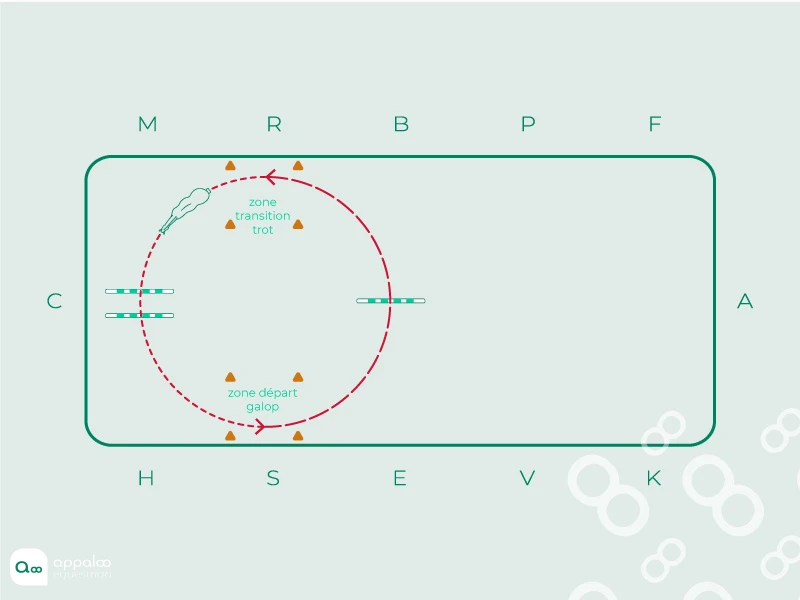
Dressage | Customizable
Obtain canter departs and transitions to walk or trot that are calm, honest and precise.
Hundreds of riding exercises shared by riders and coaches*, across every discipline: dressage, show jumping, hunter, groundwork, lungeing, equifeel, mountain trail...
Tell us your discipline, your level, your working area and the equipment you have: you only see the sessions you can actually do at home!
Dressage | Customizable
Obtain canter departs and transitions to walk or trot that are calm, honest and precise.
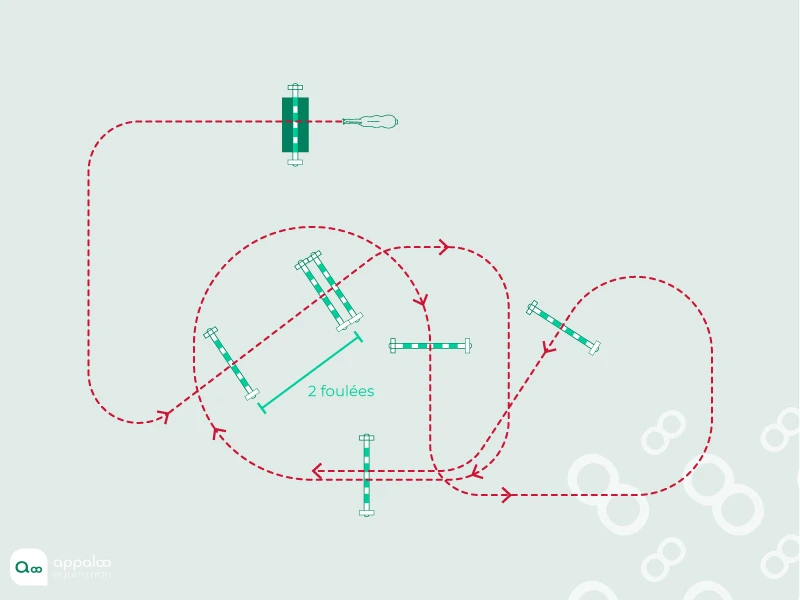
Jumping | Medium
Competition training
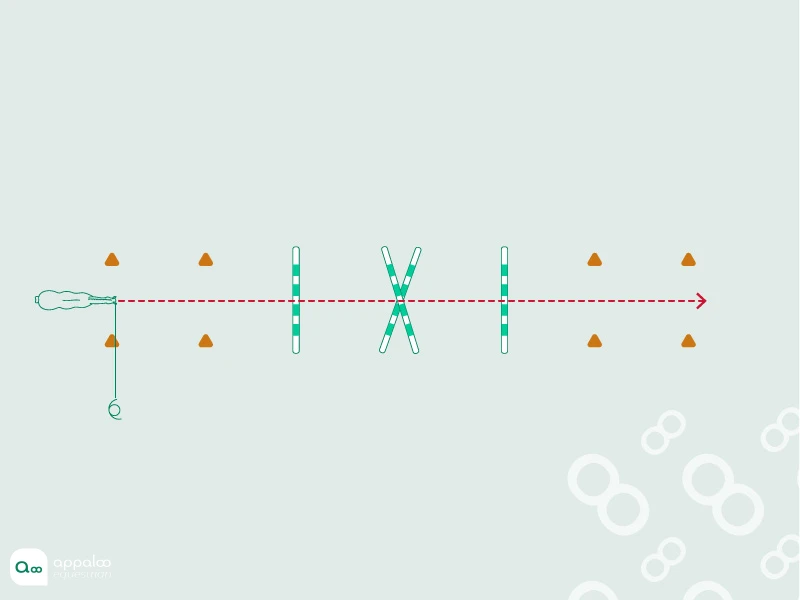
Groundwork | Customizable
Help the pony stay straight, reduce run-outs, and teach him to pay more attention to where he places his feet.
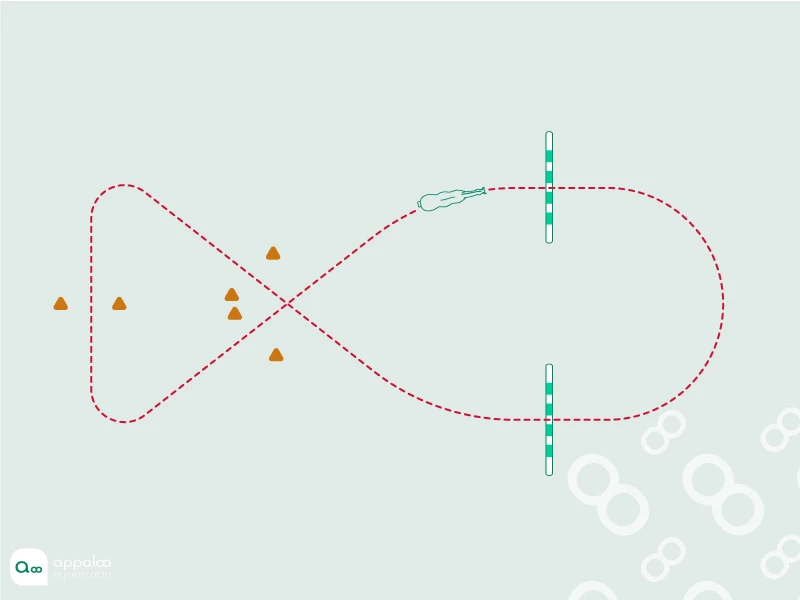
Cavalettis | Medium
Work on tight turns.
Cavalettis | Medium
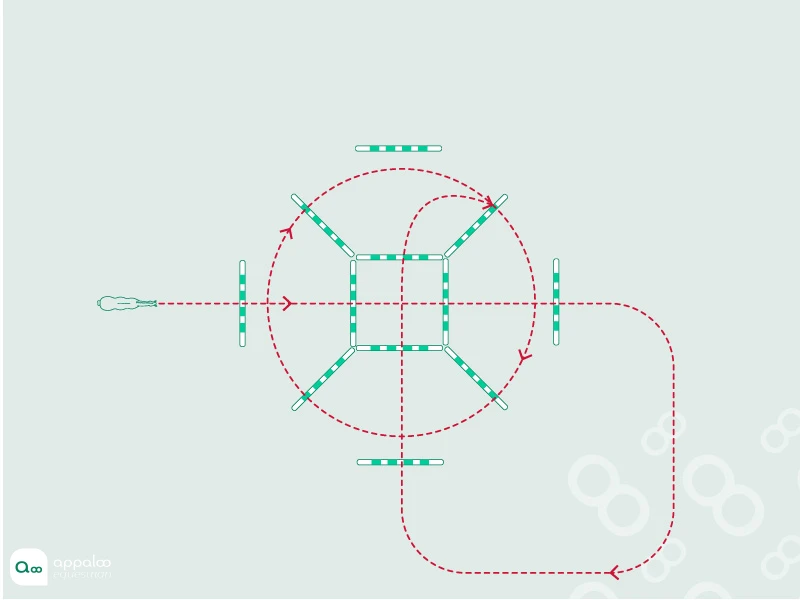
Work on rhythm and balance over an evolving geometric layout. The central square allows a straight or angled approach, offering two levels of difficulty within the same exercise. The adjustable poles then lead onto a circle on the right rein or left rein, making it an ideal tool both for the intermediate horse and for a horse in rehabilitation. The exercise also develops bend and the horse’s ability to feel and control the placement of its limbs in space — knowing where it puts its feet without looking, by playing with the approach angles.
Jumping | Medium
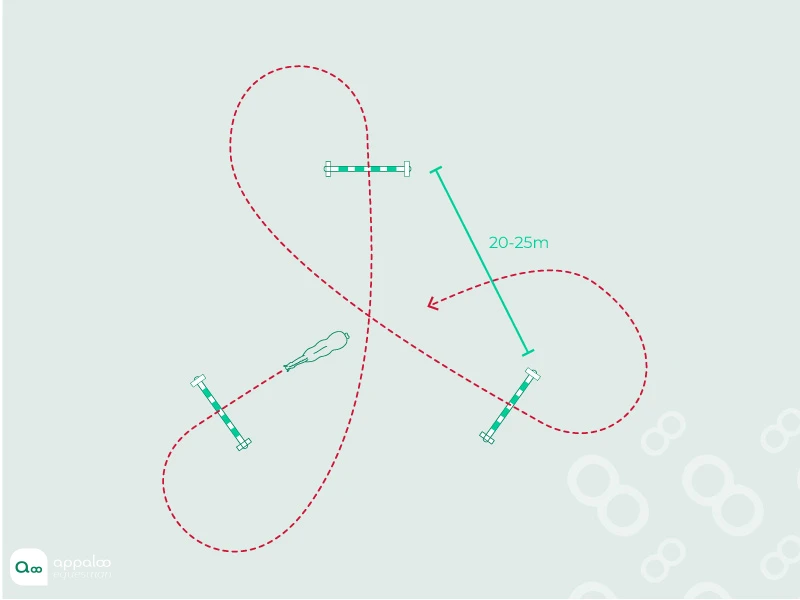
Goal: This exercise helps improve the quality of the lines to the fences, the horse’s balance in the turns, and the rider’s accuracy. It also helps to develop a more regular canter rhythm and better anticipation of the turns. The cloverleaf is an excellent exercise to prepare for show jumping courses with numerous changes of direction.
Jumping | Medium
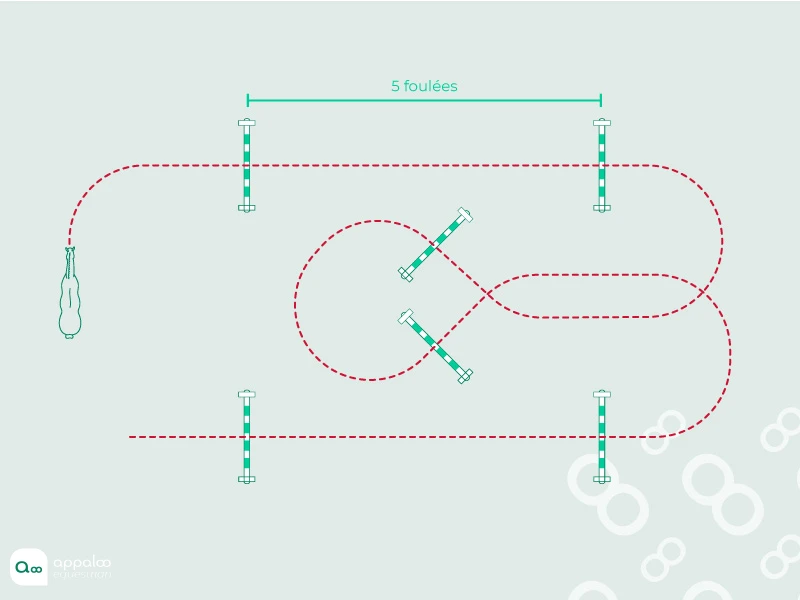
Save time in the turns and keep the horse in balance to prevent it from jumping flat.
 PREMIUM
Hunter style | Hard
In this session, you will ride a full course that brings back into play all the exercises and types of questions you’ve worked on throughout the programme. The aim is to help you reconnect everything you’ve learned in hunter seat equitation: maintaining a consistent canter rhythm, managing your lines, improving rideability, refining your approaches, and accurately reading specific course questions. Within a single course, you will therefore encounter the main hallmark elements of the discipline, and learn to link them together in a smooth, logical way. The goal is to consolidate your foundations, build your independence in the ring, and help you better understand how each question fits into the overall course design, while maintaining a quiet, accurate, and relaxed style of riding.
 PREMIUM
Hunter style | Medium
In this session, you’ll be working over another emblematic hunter fence: the spider. The aim is to school your horse to jump this exercise in its different variations with calmness, relaxation, and confidence. As with the arrowhead exercise (if you haven’t ridden that session yet, make sure you go and check it out), the work is built up in progressive stages: you start with poles on the ground, then gradually build the fence. The idea is to make sure your horse clearly understands the line he’s supposed to take, while maintaining a supple, relaxed and confident attitude at every stage of the exercise.
 PREMIUM
Hunter style | Medium
In this session, you’ll be working on a key hunter fence: the corner. The aim is to educate your horse to understand this specific type of obstacle by teaching him to clearly identify the exact line he has to jump. You will gradually introduce him to the two possible configurations, following simple, logical steps in order to build his confidence, honesty to the fence, and accuracy. The work focuses on achieving clear, consistent approaches so that your horse knows exactly where he is supposed to take off, while maintaining flow and relaxation throughout the exercise.
 PREMIUM
Hunter style | Hard
In this session, you work on a major difficulty that appears in the highest levels of club and amateur hunter classes: approaches in counter canter (false canter). This exercise requires genuine quality flatwork preparation, as your horse must be able to maintain balance and straightness without your having to excessively collect the canter. The aim is to keep a flowing rhythm and a steady outline, while managing this technical complexity with subtlety and accuracy.
 PREMIUM
Hunter style | Medium
The aim of this session is to develop the rider’s ability to adjust the length of the horse’s strides while maintaining a regular rhythm, a fundamental element in hunter seat equitation. By working down a line whose distance is deliberately set between two standard stride contracts, the rider is encouraged to explore different options: first riding the line in a reference number of strides, then a second time by adding or removing a stride. This exercise helps refine the quality of the canter, the management of balance, and the accuracy of the aids, without ever compromising the desired smoothness and flow. The goal is to learn how to adapt stride length with precision and subtlety, in order to gain control and effectiveness when reading and riding lines on course.
 PREMIUM
Hunter style | Easy
In this session, you’ll put into practice the elements you’ve worked on through a mini mixed hunter equitation course. Transitions, trot fences, mandatory passages, and angled jumps, the goal is to stay smooth, accurate, and consistent throughout the entire round.
 PREMIUM
Hunter style | Easy
In this exercise, you’ll practice approaching and jumping fences on an angle using ground pole corridors. The goal is to help your horse better understand the exercise, while developing your ability to project your eye and guide your track with precision.
 PREMIUM
Hunter style | Easy
In this exercise, you’ll learn to better manage your lines by riding through mandatory passages (PI). The goal is to tighten your turns while maintaining good balance and a steady rhythm, as required in jumper jump-offs and handy-type questions.
 PREMIUM
Hunter style | Easy
In this exercise, you’ll work on transitions and trot fences: two elements that often appear in hunter handy or under saddle-style tests. The course includes a transition zone, a small slalom, and a transition to be performed on a circle in the middle of a line. The goal is to stay precise and fluid, while maintaining control of both rhythm and track at every stage.
 PREMIUM
Hunter style | Easy
Maintain a steady rhythm in canter A simple pole exercise to help you focus on the essentials: rhythm. With a single ground pole, two 20 m lines on the ground (to be ridden in 5 or 6 strides depending on your horse) and a bounce, ride the sequence alternating between diagonal lines and the track. Your goal: find your horse’s natural canter… and keep it exactly the same from start to finish. No faster, no slower: just regular. 💡 Tip: try this exercise with music! A track that matches your horse’s canter will help you feel whether the tempo stays consistent. A real bonus to prepare for classes… sometimes even ridden to music 😉
Dressage | Easy
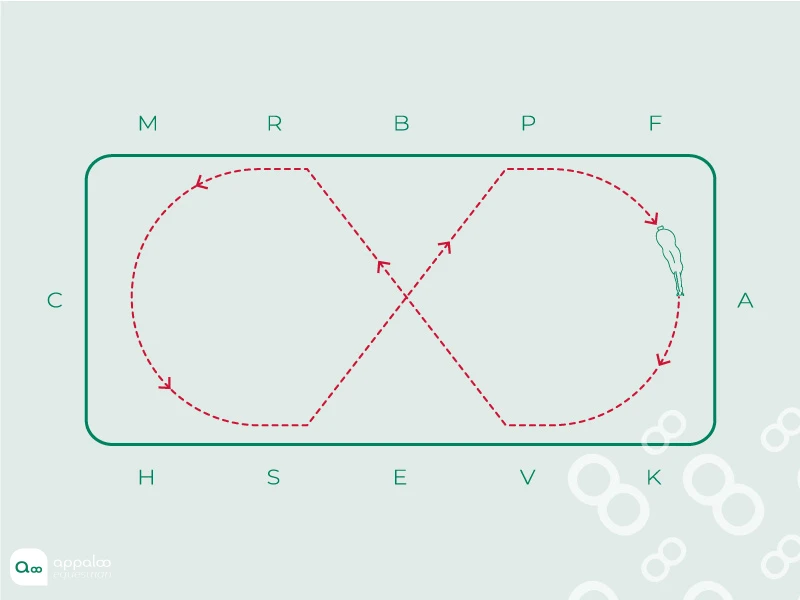
Used to work young horses on straightness, accuracy of the line and tempo
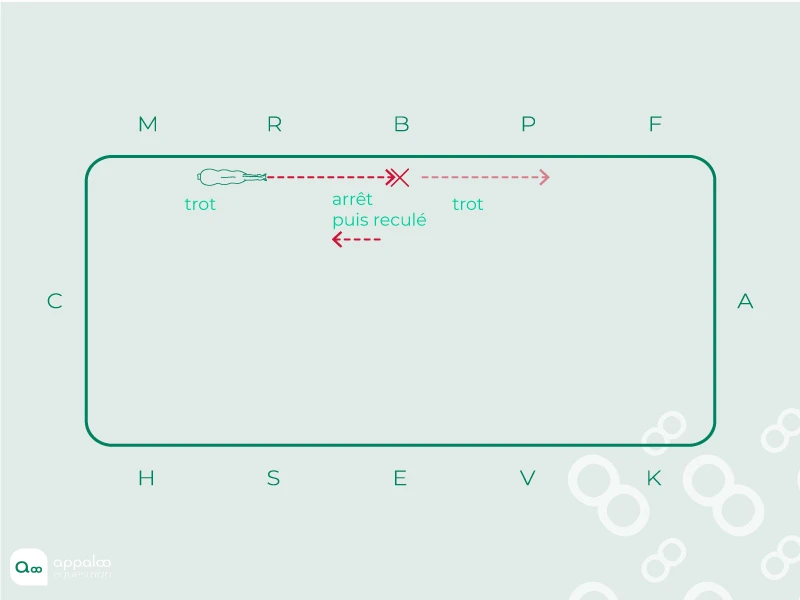
Dressage | Hard
To obtain a horse that halts promptly and in balance, steps back straight and lightly, and moves off into trot again without delay. Engagement + control + strengthening Muscles targeted: Abdominals → major work (halt + rein-back) Hindquarters → engagement under the body Back → lifts and stabilises Overall balance
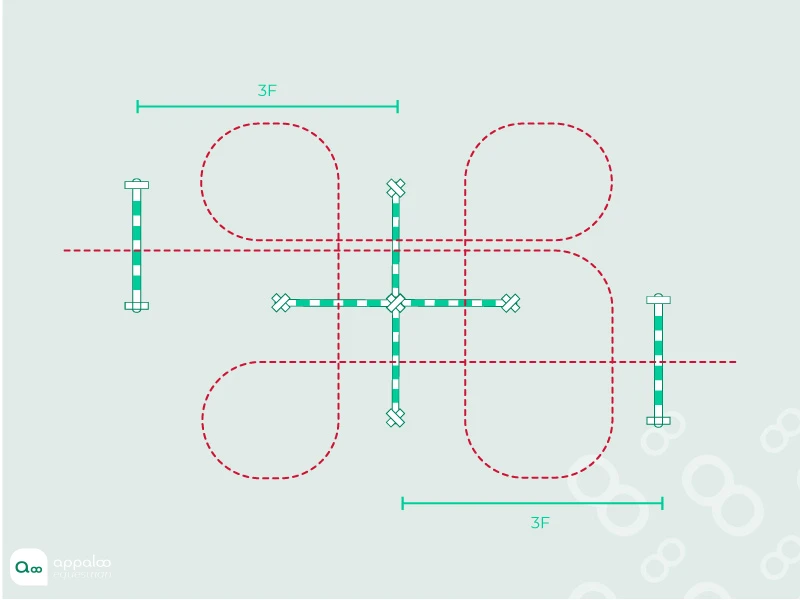
Jumping | Hard
Improve straightness over fences, the number of flying changes over the jump, and canter bend.
* Unlock every Premium session
The problem is never a shortage of ideas — they are everywhere. The problem is finding an exercise you can actually do with the horse you ride, the ground you have and whatever equipment is lying at the edge of the arena.
That is exactly what our search filters do:
Combine those four criteria and you get a tailored selection rather than a catalog to sift through. Add the exercises you like to your favorites and they stay within reach for your next sessions.
Every exercise comes as a sheet, built to be followed at the edge of the arena with your phone in hand.
That last part matters most when you ride without a coach: nobody at the arena rail to tell you why the horse rushes through the line, but the answer is written down.
Getting the spacing between poles wrong is one of the classic reasons a jumping session falls apart. Our automatic distance calculator gives you the spacing to aim for — an estimate — based on your horse's size and the gait you are working: approaches, strides, fences, ground poles. Enough to help you set your grid up right.
Looking for a course idea for jumping? Would you rather build up gradually and start with a ground pole or cavalletti exercise? Our exercise sheets cover both.
Groundwork and lungeing let you keep progressing on the days you do not ride, or with a horse coming back into work. Equifeel and mountain trail build confidence and handiness — useful well beyond their own disciplines.
Whatever your goal, the idea stays the same: we give you the ingredients, you put the session together.
We are not the only ones writing sessions — our community contributes them. Do you have an exercise that works and is not on the site yet? Submit it, and it will join the library and serve other riders.
The more you take part, the further your profile goes. Every like, every comment and every published exercise earns you points: you start out as a “Foal”, then become a “Mustang”, a “Pegasus”, up to the “Unicorn” status reserved for the most active members.
Enjoy your session!
Please sign in to save your favorites.