Introductory Hunter Course Speed Control
Created by ninah

Created by ninah
Speed control and straightness control
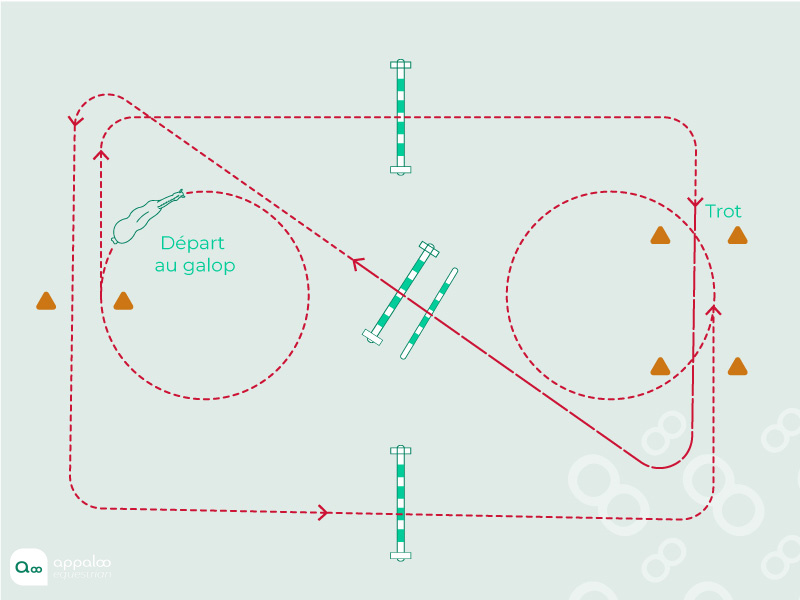
15m circle at a balanced canter to find your reference canter, jump the first vertical as straight as possible, arrive in the transition zone at a trot, jump at a trot with a placing pole, land at a canter, curve to jump the last vertical, then finish with a circle maintaining the same reference canter
Regular rhythm in curves and straight lines even while jumping - precision in transitions
No other comments at the moment
Hunter style | Hard
In this session, you work on a major difficulty that appears in the highest levels of club and amateur hunter classes: approaches in counter canter (false canter). This exercise requires genuine quality flatwork preparation, as your horse must be able to maintain balance and straightness without your having to excessively collect the canter. The aim is to keep a flowing rhythm and a steady outline, while managing this technical complexity with subtlety and accuracy.
Hunter style | Easy
In this session, you’ll put into practice the elements you’ve worked on through a mini mixed hunter equitation course. Transitions, trot fences, mandatory passages, and angled jumps, the goal is to stay smooth, accurate, and consistent throughout the entire round.
Hunter style | Easy
In this exercise, you’ll work on transitions and trot fences: two elements that often appear in hunter handy or under saddle-style tests. The course includes a transition zone, a small slalom, and a transition to be performed on a circle in the middle of a line. The goal is to stay precise and fluid, while maintaining control of both rhythm and track at every stage.
Hunter style | Medium
In this session, you’ll be working on a key hunter fence: the corner. The aim is to educate your horse to understand this specific type of obstacle by teaching him to clearly identify the exact line he has to jump. You will gradually introduce him to the two possible configurations, following simple, logical steps in order to build his confidence, honesty to the fence, and accuracy. The work focuses on achieving clear, consistent approaches so that your horse knows exactly where he is supposed to take off, while maintaining flow and relaxation throughout the exercise.
Please sign in to save your favorites.